


The Scotiabank Passport Visa Infinite Business Card is a compelling option for business owners who want straightforward rewards alongside useful travel benefits. Its flat 1.5 Scene+ points per dollar on eligible purchases makes everyday business spending easy to manage without tracking different category rates. No foreign transaction fees, six complimentary lounge visits and a broad selection of travel insurance benefits give the card particular appeal for owners who travel or regularly make foreign-currency purchases. Beyond travel, Visa Spend Clarity and Visa SavingsEdge add practical tools and savings opportunities. The $199 annual fee is easiest to justify when these benefits become part of your regular business routine. Owners who rarely travel, carry an ongoing balance or would struggle to meet the welcome offer’s spending requirements should weigh those costs carefully. Overall, this is a well-rounded business rewards card for owners who value simplicity, travel convenience and expense-management support.
Best Business Credit Cards with Expense Management Tools in Canada
- Fact checked
- Business spending
- Rewards & expense tools
RateBuddy Card Insight
Written by
 Reviewed
Good expense tools can save time after the purchase
Business card value is not just about rewards. Expense tools, reporting, employee cards, and controls can make day-to-day operations easier. RateBuddy helps compare those practical features alongside fees and rewards.
What to compare
- Reporting and bookkeeping tools
- Employee card controls
- Business reward categories
- Fees and account integration
Compare Expense Management Cards — October 2026
Last updated
Use the filters to shape the card results below. Adjust your monthly spend, narrow by provider, or highlight no-fee and welcome-bonus options — RateBuddy will quietly refresh the list so the results stay connected to your choices.

 Scotiabank®
View spending and reward-rate details
| Spending category | Monthly spend | Rate | Annual value |
|---|---|---|---|
| Groceries | $450 | 0% | $0 |
| Dining | $300 | 0% | $0 |
| Gas and transit | $150 | 0% | $0 |
| Travel | $75 | 0% | $0 |
| Recurring bills | $75 | 0% | $0 |
| Other purchases | $450 | 0% | $0 |
- No usable reward rate is configured, so spending rewards were not estimated.
This is an estimate, not a guaranteed cash return. Actual value depends on spending, eligibility, redemption choices and meeting the provider’s offer terms. Reward rates are treated as estimated cash-equivalent percentages.
Card essentials
Rates, fees and requirements
The important numbers, organized so they are easy to scan and compare.
Before you apply
Eligibility snapshot
Approval, rates and credit limits are determined by the card provider.

 TD Canada Trust
View spending and reward-rate details
| Spending category | Monthly spend | Rate | Annual value |
|---|---|---|---|
| Groceries | $450 | 1% | $54 |
| Dining | $300 | 1.5% | $54 |
| Gas and transit | $150 | 1% | $18 |
| Travel | $75 | 2% | $18 |
| Recurring bills | $75 | 1.5% | $13.50 |
| Other purchases | $450 | 1% | $54 |
This is an estimate, not a guaranteed cash return. Actual value depends on spending, eligibility, redemption choices and meeting the provider’s offer terms. Reward rates are treated as estimated cash-equivalent percentages.
Card essentials
Rates, fees and requirements
The important numbers, organized so they are easy to scan and compare.
Before you apply
Eligibility snapshot
Approval, rates and credit limits are determined by the card provider.
 TD Canada Trust
View spending and reward-rate details
| Spending category | Monthly spend | Rate | Annual value |
|---|---|---|---|
| Groceries | $450 | 1% | $54 |
| Dining | $300 | 3% | $108 |
| Gas and transit | $150 | 3% | $54 |
| Travel | $75 | 4.5% | $40.50 |
| Recurring bills | $75 | 3% | $27 |
| Other purchases | $450 | 1% | $54 |
This is an estimate, not a guaranteed cash return. Actual value depends on spending, eligibility, redemption choices and meeting the provider’s offer terms. Reward rates are treated as estimated cash-equivalent percentages.
Card essentials
Rates, fees and requirements
The important numbers, organized so they are easy to scan and compare.
Before you apply
Eligibility snapshot
Approval, rates and credit limits are determined by the card provider.
 American Express(Canada)
View spending and reward-rate details
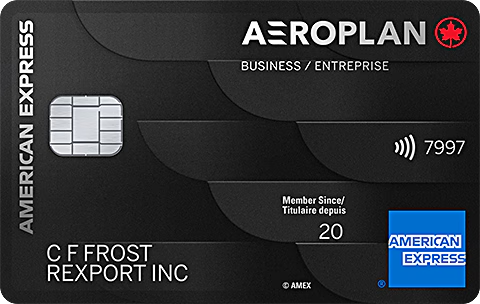
| Spending category | Monthly spend | Rate | Annual value |
|---|---|---|---|
| Groceries | $450 | 1.25% | $67.50 |
| Dining | $300 | 1.25% | $45 |
| Gas and transit | $150 | 1.25% | $22.50 |
| Travel | $75 | 3% | $27 |
| Recurring bills | $75 | 1.25% | $11.25 |
| Other purchases | $450 | 1.25% | $67.50 |
This is an estimate, not a guaranteed cash return. Actual value depends on spending, eligibility, redemption choices and meeting the provider’s offer terms. Reward rates are treated as estimated cash-equivalent percentages.
Card essentials
Rates, fees and requirements
The important numbers, organized so they are easy to scan and compare.
Before you apply
Eligibility snapshot
Approval, rates and credit limits are determined by the card provider.

 National Bank of Canada
View spending and reward-rate details
| Spending category | Monthly spend | Rate | Annual value |
|---|---|---|---|
| Groceries | $450 | 1.25% | $67.50 |
| Dining | $300 | 1.25% | $45 |
| Gas and transit | $150 | 1.25% | $22.50 |
| Travel | $75 | 1.25% | $11.25 |
| Recurring bills | $75 | 1.25% | $11.25 |
| Other purchases | $450 | 1.25% | $67.50 |
This is an estimate, not a guaranteed cash return. Actual value depends on spending, eligibility, redemption choices and meeting the provider’s offer terms. Reward rates are treated as estimated cash-equivalent percentages.
Card essentials
Rates, fees and requirements
The important numbers, organized so they are easy to scan and compare.
Before you apply
Eligibility snapshot
Approval, rates and credit limits are determined by the card provider.
 American Express(Canada)
View spending and reward-rate details
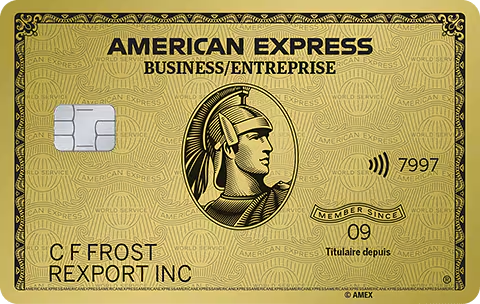
| Spending category | Monthly spend | Rate | Annual value |
|---|---|---|---|
| Groceries | $450 | 1% | $54 |
| Dining | $300 | 1% | $36 |
| Gas and transit | $150 | 1% | $18 |
| Travel | $75 | 1% | $9 |
| Recurring bills | $75 | 1% | $9 |
| Other purchases | $450 | 1% | $54 |
This is an estimate, not a guaranteed cash return. Actual value depends on spending, eligibility, redemption choices and meeting the provider’s offer terms. Reward rates are treated as estimated cash-equivalent percentages.
Card essentials
Rates, fees and requirements
The important numbers, organized so they are easy to scan and compare.
Before you apply
Eligibility snapshot
Approval, rates and credit limits are determined by the card provider.
 American Express(Canada)
View spending and reward-rate details
| Spending category | Monthly spend | Rate | Annual value |
|---|---|---|---|
| Groceries | $450 | 1.25% | $67.50 |
| Dining | $300 | 1.25% | $45 |
| Gas and transit | $150 | 1.25% | $22.50 |
| Travel | $75 | 1.25% | $11.25 |
| Recurring bills | $75 | 1.25% | $11.25 |
| Other purchases | $450 | 1.25% | $67.50 |
This is an estimate, not a guaranteed cash return. Actual value depends on spending, eligibility, redemption choices and meeting the provider’s offer terms. Reward rates are treated as estimated cash-equivalent percentages.
Card essentials
Rates, fees and requirements
The important numbers, organized so they are easy to scan and compare.
Before you apply
Eligibility snapshot
Approval, rates and credit limits are determined by the card provider.
 TD Canada Trust
View spending and reward-rate details
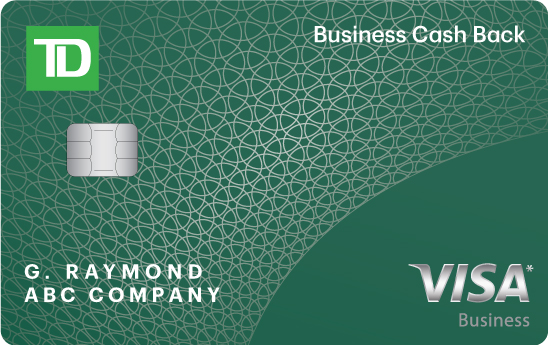
| Spending category | Monthly spend | Rate | Annual value |
|---|---|---|---|
| Groceries | $450 | 0.5% | $27 |
| Dining | $300 | 0.5% | $18 |
| Gas and transit | $150 | 2% | $36 |
| Travel | $75 | 2% | $18 |
| Recurring bills | $75 | 2% | $18 |
| Other purchases | $450 | 0.5% | $27 |
This is an estimate, not a guaranteed cash return. Actual value depends on spending, eligibility, redemption choices and meeting the provider’s offer terms. Reward rates are treated as estimated cash-equivalent percentages.
Card essentials
Rates, fees and requirements
The important numbers, organized so they are easy to scan and compare.
Before you apply
Eligibility snapshot
Approval, rates and credit limits are determined by the card provider.
 Scotiabank®
The Scotia Home Hardware PRO Visa Business Card is a practical choice for business owners who regularly purchase supplies from Home Hardware and want to keep annual card costs at zero. Free supplementary cards and Visa Spend Clarity help bring employee spending into one manageable account, while Scene+ points add value to eligible Home Hardware purchases. Purchase security, extended warranty protection and participating merchant discounts provide useful supporting benefits. Its appeal is strongest when Home Hardware is already part of your business spending routine. The earning structure is focused on eligible Home Hardware purchases, so broader spending will not earn the same standard card rewards. Borrowing costs also depend on Scotiabank Prime and your approved adjustment factor. For businesses that value those specific purchasing and expense-management benefits, it offers a straightforward account without an annual fee.
Card essentials
Rates, fees and requirements
The important numbers, organized so they are easy to scan and compare.
Before you apply
Eligibility snapshot
Approval, rates and credit limits are determined by the card provider.
 TD Canada Trust
Card essentials
Rates, fees and requirements
The important numbers, organized so they are easy to scan and compare.
Before you apply
Eligibility snapshot
Approval, rates and credit limits are determined by the card provider.
Math. Not Marketing.
We calculate the true value to save you every penny.
Data-Driven Logic
Rankings based on hard numbers (fees vs rewards), not advertising budgets.
100% Unbiased
We highlight the "gotchas" and fees just as clearly as the perks.
Direct & Secure
No data harvesting. We send you straight to the bank's secure official site.
Why Choose a Credit Card?
Beyond simple convenience, the right credit card offers a layer of consumer protection, financial leverage, and rewards that debit cards or cash simply cannot match.
Zero Liability Protection
Canadian credit cards come with robust federal protections against unauthorized transactions. Unlike cash, which is gone forever if lost, or debit cards which are directly linked to your bank funds, a credit card offers a buffer. If your card is used fraudulently, you are generally not held liable for those charges once reported. This keeps your actual bank account safe and liquid while the bank investigates the issue. It provides peace of mind in an era of increasing digital fraud.
Value-Added Rewards
Every purchase you make is an opportunity to earn a return on your spending. Whether you prefer travel points, merchandise, or cash back, using a credit card allows you to get value back on expenses you were going to pay anyway. Over the course of a year, a standard 1-2% reward rate can accumulate into hundreds of dollars in free groceries or flights. It is effectively a discount on your entire lifestyle, provided you pay your balance in full. Why pay full price with cash when you can earn a rebate with credit?
Building Credit History
Your credit score is your financial passport in Canada, dictating your ability to rent apartments, get a mortgage, or finance a car. Responsible credit card use is one of the most effective and fastest ways to establish this history. By using a card and paying it off on time every month, you demonstrate reliability to future lenders. A long, positive history with a credit card accounts for a significant portion of your credit score calculation. Without this history, obtaining major loans later in life can be difficult or much more expensive.
Crunch The Numbers
See exactly how much you can save, earn, or pay off.
Explore the Ecosystem
Discover more ways to save, earn, and optimize your wallet.
Explore other possibilities.
Credit Cards is great, but sometimes a different card fits your lifestyle better. Use our Smart Finder to see what else you qualify for.
Cash Back
Earn money on daily spend.
Travel Rewards
Best for frequent flyers.
Find best cards by features:
Filter our database by the specific perks and coverages that matter to you.
Browse by Bank & Issuer:
Filter our database to see offers from specific Canadian financial institutions.
Browse by Reward Program:
Already collect points? Find the card that accelerates your existing balance.
A little clarity, before you choose
Make the card fit your life.
Explore the bigger picture, check the numbers and find the tradeoffs that matter to you.
The Canadian picture
The Bank of Canada’s 2025 survey estimates that 89% of adults owned a credit card. Credit cards accounted for 48.2% of purchases recorded in its diary by number; 31% of cardholders reported not paying their full balance in the previous month.
Source: Bank of Canada · 2025 Methods-of-Payment Survey (published August 2026)What this means for your comparisonOur interpretation: a card can be an everyday payment tool or an expensive way to borrow. The right comparison starts with how you repay, then considers rewards and benefits.
How do you choose a card that actually fits?Compare the Canadian market through your spending, borrowing costs and everyday needs.
A useful card comparison starts with a question about your life: will this card mainly help you pay, borrow, travel or build a payment history? Those jobs need different comparisons. A large welcome offer can be attractive, but it cannot tell you whether the card will still work for you a year from now.
Read the market in layers
Think of the Canadian card market as several overlapping choices. The issuer sets the account agreement. The payment network affects where the card can be used. A rewards program determines what you earn and how you can redeem it. A benefits package adds services or coverage with its own conditions. Comparing only the network name or the points total leaves important parts of the decision out.
Our analysis is to separate three kinds of value: everyday value, introductory value and borrowing cost. Everyday value comes from spending you would make anyway. Introductory value is temporary and may depend on meeting a spending requirement. Borrowing cost comes from the balance, rate and repayment schedule. A card can look strong in one layer and weak in another.
The Financial Consumer Agency of Canada (FCAC) recommends comparing interest rates, fees, rewards and benefits. It also notes that restrictions, unused benefits and interest can reduce the value of a rewards card. Use that framework, then put your own numbers into it.
| Your main job for the card | Start by comparing | Question to ask |
|---|---|---|
| Everyday purchases paid in full | Net rewards, merchant fit and fees | What will I keep after a normal year? |
| Paying down existing debt | Total repayment cost and time | Can I afford the payment that clears this balance? |
| Travel | Usable redemptions and relevant benefits | Does this work for the trips I actually take? |
| A first or rebuilding card | Manageability, eligibility and account cost | Can I run this account reliably each month? |
Build a normal-year comparison before adding a bonus
Take a few recent statements or a household budget and group the purchases you can actually put on the card. Do not include rent, taxes or other bills automatically: first check whether the payee accepts the card and charges an extra fee. Separate grocery, dining, fuel, transit and general spending where the offer uses different earning rates. Include the months when your spending falls, not just your busiest month.
Worked example: a bigger rate is not automatically a better result
Suppose your eligible annual spending is $18,000. A hypothetical no-fee card earning 1.5% on all of it returns $270. A second hypothetical card earning an effective 2% after its category mix returns $360, but costs $120 a year. Its normal-year result is $240.
$360 rewards − $120 fee = $240, compared with $270 on the no-fee alternative.
Without other usable benefits, the higher-rate card leaves you $30 behind. A one-time bonus might change the first-year result; it does not change this renewal-year comparison. These assumptions exclude interest, other fees and spending caps.
Compare an ordinary month and a difficult month
For someone who pays in full, everyday rewards may be the deciding factor. For someone who expects to carry debt, run a separate repayment comparison first. Mixing hoped-for rewards with uncertain borrowing costs can hide the more important issue. Use an affordable payment amount and allow for a month when income or expenses change.
For business spending, also consider who can use the account, how employee purchases are controlled and whether statements support your records. A rewards advantage is less useful if account administration becomes difficult. For travel, check merchant acceptance and conversion costs on the route you expect to use, rather than assuming every card is equally convenient abroad.
Keep the final decision grounded
Compare the card with your current setup, not just the other advertised offers. Write down the main reason for changing and the condition that would make you reconsider at renewal. Keep a copy of the offer you relied on. Where a provider welcome offer and a RateBuddy rebate both appear, track their requirements separately; neither should be treated as already earned in your recurring-rewards estimate.
A useful choice: the card should improve a job you already need done, at a cost and level of effort you can sustain.
When is an annual fee worth paying?Measure usable benefits against a practical alternative, including renewal costs.
An annual fee buys a package. Its value depends on which parts of that package you can use and what a sensible alternative would cost. A card with a fee can be worthwhile; a card without one can still be the stronger choice for your situation.
Use incremental value, not the brochure total
Compare the fee card with a practical no-fee or lower-fee alternative. Subtract the rewards you would already earn on that alternative before valuing the upgrade. Then add benefits you would genuinely use, at an amount you would reasonably pay for them. FCAC’s card-selection guidance highlights comparing annual fees with usable benefits and checking similar no-fee options.
Retail prices can exaggerate personal value. If a lounge pass is marketed at $60 but you would otherwise eat at the gate for $15, $60 is not necessarily your saving. If a travel credit requires a more expensive booking channel, compare the complete booking price. Benefits you already receive from another card or an employer should not be counted twice.
Worked example: the renewal-year upgrade test
| Incremental annual value or cost | Amount |
|---|---|
| Extra rewards compared with the alternative | +$150 |
| Two usable benefits valued at $25 each | +$50 |
| Additional annual fee | −$120 |
| Net advantage | +$80 |
If the benefits go unused, the advantage falls to $30. If the extra rewards also fall from $150 to $100, the card is $20 behind. That sensitivity matters more than adding up every listed benefit at its advertised price.
For rewards alone, a $120 additional fee with an extra 0.5 percentage points of return requires $24,000 of eligible annual spending to break even: $120 ÷ 0.005. Caps, exclusions, interest and other costs are not included in that simplified threshold.
Insurance needs a coverage comparison
Emergency medical, trip cancellation, trip interruption, rental-car damage and purchase protection are different benefits. The Government of Canada advises checking policy conditions, exclusions and requirements before travel. Its guidance also distinguishes medical coverage from interruption and cancellation, and highlights issues such as pre-existing conditions and trip duration.
Read the current certificate for the people, trip and purchases you want covered. Check age, eligible family members, the length of the trip, payment requirements, exclusions, deductible and the claims process. Assign value only after confirming that it meets a need you would otherwise pay to cover. Do not assign an insurance policy’s maximum payout as an annual benefit value.
A fee waiver can have another cost
A linked bank account or first-year waiver can change the comparison, but check its conditions. For illustration, keeping an additional $5,000 idle to obtain a card-fee waiver has a $150 annual opportunity cost if that money could otherwise earn 3% before tax. If the bank account also replaces services you would buy anyway, include those benefits separately. The result depends on your actual alternatives, not a universal interest assumption.
For foreign-currency spending, compare the entire conversion cost and rewards rather than just one fee label. A card billed in U.S. dollars also needs a plan for how you acquire and repay those dollars. Keep currency assumptions consistent before comparing a Canadian-dollar annual fee with savings on foreign purchases.
Evaluate the year you will renew
Remove one-time welcome points and promotional fee waivers, add any supplementary-card cost and use normal spending. Put a reminder before renewal to check whether your travel or household needs have changed. For business cards, include administration and employee-account needs, while keeping any tax treatment outside this general consumer comparison.
A fair fee comparison: count additional value you can use, deduct the additional cost and repeat the check without first-year incentives.
Browse by Network:
Filter by Visa, Mastercard, or Amex acceptance.
Browse Cards by Tier:
From entry-level options to exclusive black cards. Find the eligibility level that fits you.
Frequently Asked Questions
Common questions about Compare Expense Management Cards Cards and financial strategy.
Disclaimer: Information is for educational purposes only and does not constitute financial or legal advice. Terms subject to change by issuers.
Still have questions?
Visit our Financial Education HubTools & Resources
Master your money with our suite of free calculators and guides.